Wednesday, December 13, 2006

Code Re-use

This code was anonymised by the sender and some of the original logic may be a bit harder to make sense of as a result. Instead of EMP records, you should probably imagine it checking billion-dollar financial deals or nuclear reactor core temperature readings. Anyway, I think I've figured out what it's supposed to do.

You pass in an EMP record containing first name, last name, email address and so on, and it calls OTHER_PROC(email_address, the_emp_record_as_passed_in) - but only if the email address is not null, and it is unique for employees with that name. For some reason. But how to check? Simple:

  1. Use a cursor to load all the rows for that name into an array. (Apparently there were 130+ columns in the original table.)
  2. Check array.COUNT to see how many rows there are.
  3. If there is only one row, use it, taking care to use an NVL expression because we definitely don't want a NULL email address.
  4. If there is more than one row, open the same cursor again, and this time loop through it comparing each row's email address with the previous one. If it's the same, set lv_email_same = 1, otherwise set it to 0. That way, at the end of the loop we'll know whether they were all the same or not, right?

PROCEDURE unleash_havoc (p_emp_rec emp%rowtype)
IS
   lv_email_same  NUMBER(1) :=0; -- 0: no, 1: yes
   lv_email_null  NUMBER(1) :=0; -- 0: no, 1: yes
   lv_email       emp.email%TYPE := NULL;
   ln_row         NUMBER;

   TYPE emp_tab IS TABLE OF emp%ROWTYPE;
   lt_emp_data  emp_tab;

   CURSOR c_emp (p_last_name VARCHAR2, p_first_name VARCHAR2) IS
      SELECT *
      FROM   emp e
      WHERE  e.last_name = p_last_name
      AND    e.first_name = p_first_name;

BEGIN
   OPEN c_emp (p_emp_rec.last_name, p_emp_rec.first_name);
   FETCH c_emp BULK COLLECT INTO lt_emp_data;
   CLOSE c_emp;

   IF lt_emp_data.COUNT = 1 THEN
       ln_row := lt_emp_data.FIRST;
       lv_email  := NVL(lt_emp_data(ln_row).email,NULL);
       other_proc(lv_email,p_emp_rec);

   ELSIF lt_emp_data.COUNT > 1 THEN

       FOR r IN c_emp (p_emp_rec.last_name, p_emp_rec.first_name) LOOP
           IF NVL(r.email,'X') = NVL(lv_email,'X') THEN
               lv_email := r.email;
               lv_email_same := 1;
           ELSE
               lv_email := r.email;
               lv_email_same := 0;
           END IF;

           IF r.email IS NULL THEN
               lv_email_null := 1;
           ELSE
               lv_email_null := 0;
           END IF;
       END LOOP;

       IF  lv_email_same = 1
       AND lv_email_null = 0
       THEN
           lv_email  := NVL(lt_emp_data(ln_row).email,NULL);
           other_proc(lv_email,p_emp_rec);
       ELSE
           ...
       END IF;
   END IF;
END;
Thursday, October 19, 2006

Pause For Thought part 2

In an AskTom thread about native compilation, a poster mentions that he is seeing some big CPU waits on his system and wonders whether native compilation would help. After some discussion of tracing and profiling and his 32 Tuxedo connections, he reports back that from talking to the programmer (possibly this guy), he might have narrowed the problem down to a procedure called DELAY():

I just happened to talk to the programmer and what i understand is that that specific function when called so many times , it is internally calling a procedure with passing a value n, where n is like 4,5,6 etv. That procedure is called delay and its job is to create a delay in the logic flow. So the delay procedure accepsts values like 10 as seconds and then it
FOR di IN 1..sed LOOP
   NULL;
END LOOP;
A random thought, could this when run so many times accumulate huge cpu?

Tom thinks maybe it might.

Thanks Tom for sending this in.

Thursday, October 12, 2006

Death By Furniture

According to www.identifiers.org, there are two classes of relational database: "Code Class" and "Identifier Class".

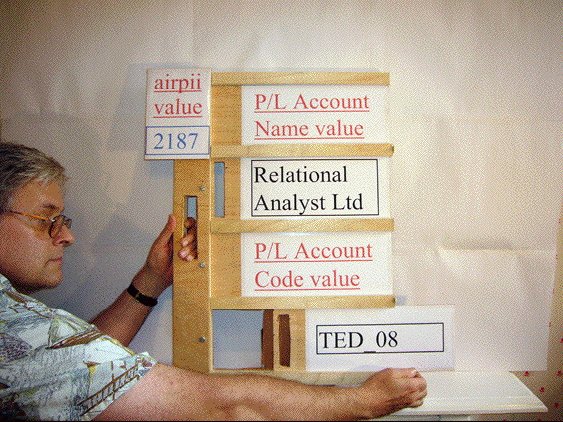
We hadn't heard of those either, but it's all made clear in this presentation (pdf, 1.2MB), in which the limitations of the conventional approach and a novel approach to schema design are explained without the aid of Powerpoint, in a series of pictures like this one:

Still confused? Never mind, you can follow the debate on this OTN thread, which George begins by asking for a simple clarification regarding the capabilities of the Oracle RDBMS. From the answers to this, he should be able to determine whether Oracle is old-hat Code Class or funky new Identifier Class:

I have an interest in establishing how the Oracle System Catalogues cope with particular changes. I have never used Oracle, but I have carried out the same test on another RDBMS. If I had access to Oracle I would have carried out this test myself.

The test goes as follows.

Create a new database.

Create a new simple table, with just a few columns.

Create a form for the table, and add a few rows.

Rename the table or a column – if you can’t, then the RDBMS is Code Class.

If you can rename the table or a column, then do so, and invoke the form that you used before changing the table or column name. If it doesn’t work, the RDBMS is Code Class; if it does then the RDBMS is Identifier Class.

In an Identifier Class RDBMS changes of column or relation/table name will not interfere with the operation of any form already in place based on that table.

I'll be very grateful if anybody can give me a definitive answer on this, either through already having explored the issue or by running the test.

It turns out that "Code Class" covers all existing RDBMS products ever conceived, and "Identifier Class" is an improved model invented by George himself, in which some theoretical 4GL development tool yet to be designed allows you to change table and column names without breaking existing code or having to define a view, and surrogate keys are, well, pretty much the same except that they are now called attribute independent relative position independent identifiers. Perhaps one day Oracle will advance to this point, especially now that they've fixed DBMS_OUTPUT and must be wondering what to do next (perhaps after getting a product to work on Apple Mac and fixing the OTN "change password" facility). We can but dream.

Saturday, September 16, 2006

Useful books

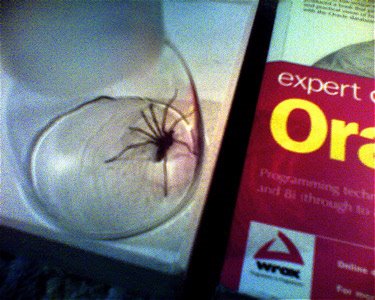
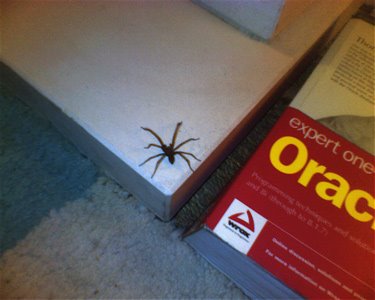
An enormous spider appears. It's clearly coming for you. Or not. What do you do?

Staying calm, place a glass or similar containment device over the creature.

Now gently slide a card under the glass, taking care not to trap any legs. There should be eight after you have completed this manoeuvre.

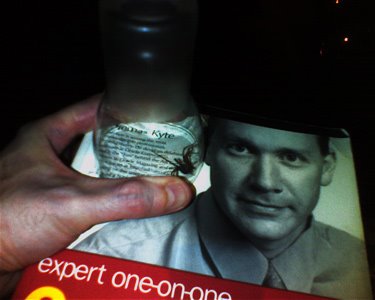
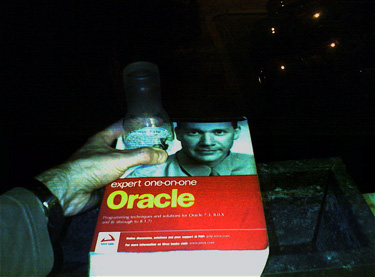
Transfer to a suitable platform such as a book, and carry to a window or other suitable release location.

No Oracle experts were harmed in the making of this blog.

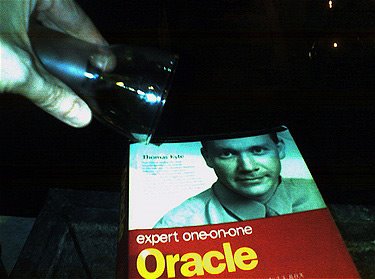
Reintroduce the creature into the wild, where it can begin a new life free to roam among its own kind. Or just wander back in of course, but spiders are not known for their homing instinct. Or are they? To be honest we haven't checked. This one said something about "Scotland" and "revenge".

Finally, always sterilise your equipment.

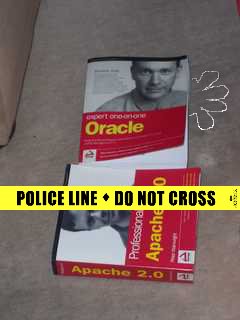
Meanwhile in Edinburgh, police were called to a flat in the Stockbridge area following reports of a violent assault...

Wednesday, September 13, 2006

Just, Why?

I'm currently debugging a procedure of the form illustrated below, lovingly recreated using the ubiquitous scott.emp table. I'm also taking suggestions on what might've been going through the head of the person who wrote it.

RENAME emp TO emp_table
/
CREATE OR REPLACE VIEW emp
AS
   SELECT *
     FROM emp_table
/
CREATE OR REPLACE TRIGGER mod_emp
   INSTEAD OF UPDATE
   ON emp
   FOR EACH ROW
DECLARE
   new_emp                       emp_table%ROWTYPE;
   old_emp                       emp_table%ROWTYPE;
BEGIN
   new_emp.empno       := :NEW.empno;
   new_emp.ename       := :NEW.ename;
   new_emp.job         := :NEW.job;
   new_emp.mgr         := :NEW.mgr;
   new_emp.hiredate    := :NEW.hiredate;
   new_emp.sal         := :NEW.sal;
   new_emp.comm        := :NEW.comm;
   new_emp.deptno      := :NEW.deptno;
   old_emp.empno       := :OLD.empno;
   old_emp.ename       := :OLD.ename;
   old_emp.job         := :OLD.job;
   old_emp.mgr         := :OLD.mgr;
   old_emp.hiredate    := :OLD.hiredate;
   old_emp.sal         := :OLD.sal;
   old_emp.comm        := :OLD.comm;
   old_emp.deptno      := :OLD.deptno;
   update_emp (old_emp, new_emp);
END;
/

CREATE OR REPLACE PROCEDURE update_emp (
   old_emp                             emp_table%ROWTYPE
  ,new_emp                             emp_table%ROWTYPE
)
IS
BEGIN
   IF old_emp.empno != new_emp.empno
   THEN
      RETURN;   --can't update primary key attribute
   END IF;

   IF     old_emp.empno IS NOT NULL
      AND new_emp.empno IS NULL
   THEN
      DELETE FROM emp_table
            WHERE empno = old_emp.empno;

      RETURN;
   END IF;

   IF    (    old_emp.ename IS NULL
          AND new_emp.ename IS NOT NULL)
      OR (    old_emp.ename IS NOT NULL
          AND new_emp.ename != old_emp.ename)
   THEN
      UPDATE emp_table
         SET ename = new_emp.ename
       WHERE empno = old_emp.empno;
   END IF;
   -- ..
   -- ..
   -- ..
   IF    (    old_emp.deptno IS NULL
          AND new_emp.deptno IS NOT NULL)
      OR (    old_emp.deptno IS NOT NULL
          AND new_emp.deptno != old_emp.deptno)
   THEN
      UPDATE emp_table
         SET deptno = new_emp.deptno
       WHERE empno = old_emp.empno;
   END IF;
END;
/

Saturday, September 09, 2006

A Year of WTFs

Each year, the Oracle WTF organisation celebrates its anniversary by inviting a fellow Oracle professional to share an evening of fine Eastern European lager and disappointing bar snacks in a pub where you can't hear each other properly, and this year it was the turn of former newbie (but now of course senior expert) DBA Lisa Dobson.

Actually that's not quite true - I realised today it was just over a year ago that we started the blog, and the other evening some of us met up with Lisa who happened to be in town, and if I'd thought of this a bit earlier I could probably have pretended it was all planned. Anyway it was nice meeting Lisa, and we enjoyed the story about the colleague who accidentally deleted the entire production server, as luck would have it a week after the server room air conditioning took out the only other server by dripping a surprisingly large amount of water into it. That rather outdid my story about the day we turned up for work at a client's site and found nobody could log in, because as it happened someone had stolen the servers during the night. Or the other one, if I'd remembered to tell it, about the high street retail chain whose backup system involved a PC and a timer plug. (I shouldn't laugh - it actually worked quite well.) It was also reassuring to hear we are not the only ones who don't understand a single bloody word of those "Oracle" blogs about installing a Java framework in JDeveloper to implement service-oriented BPEL with a right-click and some XML. Umm, neat.

It seems we're also not the only ones to have been shocked and saddened by Doug Burns' recent senseless killing spree. This monster must be stopped. (...is probably what Doug said as he reached for his copy of "Expert One-On-One Oracle").

Anyway, one year, 63 posts, and some lessons learned:

  1. Post one of Tom Kyte's pet hates like WHEN OTHERS THEN NULL (or WHEN OTHERS THEN DBMS_OUTPUT, which isn't much better quite frankly) for a mention on his blog and a surefire thousand hits. We need one about IM Speak now b/c im sure u will C loadsa hits ;-)
  2. Post something involving security for a mention on Pete Finnigan's site. We also get a steady stream of visitors googling for "forgot system password +oracle", "how to get password of a user in oracle" and so on, and being directed to Umm, I Forgot My Password, part 2. (In future just put it on a Post-It under your keyboard like everyone else.)
  3. Titles involving common Oracle error codes seem to do well. A lot of visitors come here from a Google search for SP2-0552 (guys, you have a variable with a colon in front of it somewhere). We need some posts about ORA-0600 or TNSNAMES.
  4. A lot of people seem to be searching for an explanation of joins and end up at our Joins Explained, heaven help them, where a Mr Sanders Kaufman explains things like "Left Joins are joined on the left columns of two tables. Right Joins are joined on the right columns of two tables." I'm glad we got that cleared up.
  5. Google Analytics Rock. So (while we're at it) do Statcounter, Feedburner and CoComment.

We were recently offered some sponsorship by price comparison website Shopzilla (or rather, they emailed me a week ago and I remembered it in the pub). The consensus among those present was that we should not accept it, although personally I think all that would change if we could get The Daily WTF's Beanbag Girl.

We were also kindly offered a spot on Pythian Group's Logfile Of The Vanities or whatever it's called (or rather, they emailed me a month ago and I seem to have deleted the message, sorry guys, meant to get back to you) but I didn't take them up on it, partly because there didn't seem much point in writing a piece telling people about Oracle blogs they already read (surely?) via blogs.oracle.com, and also because it's explicitly for DBAs, and with the possible exception of Padders we are all developers (even though these days "developer" is often assumed to mean someone who is into aspect-oriented JDeveloper BPEL plug-ins). Our main thing is SQL, PL/SQL and data modelling, and AFAIK none of those have much to do with the DBA role. In fact, thinking about it I'm not sure why they asked. And is that Pie-thian as in Pythagoras and Python, or Pith-ian as in Gryffindor and Slytherin, anyway?

Saturday, August 19, 2006

Competition

Well, not really a competition because we haven't got any prizes to give away, but the code below (thanks Padders) has a real "How Many WTFs Can You Spot?" feel about it. I make it four.

PROCEDURE log_error
    ( p_source  IN  VARCHAR2
    , p_result  IN  VARCHAR2)
IS
    PRAGMA AUTONOMOUS_TRANSACTION;
    p_primarykey errorlogging.primarykey%TYPE;
BEGIN
    SELECT errorlogging_seq.NEXTVAL
    INTO   p_primarykey
    FROM   dual;

    INSERT /*+ APPEND */ INTO errorlogging NOLOGGING
    ( primarykey
    , source
    , result
    , timestamp
    , wherewasi
    , processed_count
    , process_id )
    VALUES
    ( p_primarykey
    , p_source
    , SUBSTR(p_result, 1, 1000)
    , SYSDATE
    , NULL
    , NULL
    , 1 );

    COMMIT;
EXCEPTION
    WHEN OTHERS THEN NULL;
END;

Tuesday, August 08, 2006

Show Me The Money

Money, money, money. It's a rich man's world. It can't buy you love, but as we are constantly reminded it can buy you cheap Levitra and pre-approved loans, and those are just as good and will probably boost this site's stats. It makes the world go round. It's great - but how to format it?

Well, here is one way. The editing history tells the whole story.


/*=============================================================================
Procedure:    FN_FORMAT_DOLLARS
Description:  Formats a number as dollars (2 decimals)

MODIFICATION HISTORY:
Person        Date        Comments
---------     ------      -------------------------------------------
XX            01/24/03    Created
SF            08/05/03    Rewrote the function as a TO_CHAR statement
==============================================================================*/

FUNCTION fn_format_dollars (p_dollars IN NUMBER)
    RETURN VARCHAR2
IS
    -- v_dollars   VARCHAR2 (50);
BEGIN

    /*
    v_dollars := TO_CHAR (p_dollars);
    IF INSTR (v_dollars, '.') = 0
    THEN
        v_dollars :=  v_dollars  || '.';
    END IF;

    -- too many decimal places...
    WHILE   LENGTH (v_dollars) - INSTR (v_dollars, '.') > 2
    LOOP
        v_dollars := SUBSTR (v_dollars, 1, LENGTH (v_dollars) - 1);
    END LOOP;

    -- not enough decimal places...
    WHILE   LENGTH (v_dollars) - INSTR (v_dollars, '.') < 2
    LOOP
        v_dollars := v_dollars || '0';
     END LOOP;
    */

    RETURN TO_CHAR(p_dollars, 'FM999999999990.00');

END fn_format_dollars;

Many thanks to rd for sending this in.

Monday, July 17, 2006

The fine line between clever and stupid

Stojka Mongo began to be concerrned when he came across table AT_ILOAD_DAYS that looked like this:

CREATE TABLE at_iload_days
( daystring      VARCHAR2(8)
, batch_created  VARCHAR2(1)  DEFAULT 'N' );

where "daystring" contained values like "20030901".

Then he found this convenient procedure to "fill" it:

CREATE OR REPLACE PROCEDURE pr_generate_iload_days
AS
    -- Procedure to fill days from most recent entry in at_iload_days up to current sysdate */
    d_date_string    VARCHAR2(8) DEFAULT NULL;
    d_maxdate_string VARCHAR2(8) DEFAULT NULL;
BEGIN
    -- sysdate will be max date to generate:
    d_maxdate_string := TO_CHAR(SYSDATE, 'yyyymmdd');

    -- Fetch most recent datestring from at_iload_days + 1 day into d_date_string
    -- (default to commercial launch date)
    EXECUTE IMMEDIATE
    'select to_char((to_date(nvl(max(daystring),''20030505''),''yyyymmdd'')+1),''yyyymmdd'') from at_iload_days'
    INTO d_date_string;

    -- We shouldn't load data that will exist in the future, should we?
    IF d_date_string <= d_maxdate_string THEN
        EXECUTE IMMEDIATE
        'insert into at_iload_days (daystring,batch_created) values (' ||
        '''' ||d_date_string || '''' || ',''N'')';

        EXECUTE IMMEDIATE 'COMMIT';
    END IF;
END pr_generate_iload_days;

Our favourite line:

EXECUTE IMMEDIATE 'COMMIT';

It's hard to tell but I think that procedure can be rewritten as:

CREATE OR REPLACE PROCEDURE pr_generate_iload_days
AS
BEGIN
    INSERT INTO at_iload_days (daystring)
    SELECT TO_CHAR
           ( TO_DATE(NVL(MAX(daystring),'20030505'),'yyyymmdd')+1
           , 'yyyymmdd' )
    FROM   at_iload_days
    HAVING NVL(MAX(daystring),'20030505') <= TO_CHAR(SYSDATE, 'yyyymmdd')
END pr_generate_iload_days;

although if DAYSTRING had actually been a date, it would have just been:

CREATE OR REPLACE PROCEDURE pr_generate_iload_days
AS
BEGIN
    INSERT INTO at_iload_days(day)
    SELECT NVL(MAX(day), DATE '2003-05-05') +1
    FROM   at_iload_days
    HAVING NVL(MAX(day), DATE '2003-05-05') <= SYSDATE;
END pr_generate_iload_days;

Thanks 3360 for the title for this post.

Saturday, July 15, 2006

Pause for thought

Requirement:

Can I let a procedure wait for a specific time (10 seconds) before inserting values into a table?

One solution (according to a poster on OTN - don't try this at home):

declare
  dStart DATE := SYSDATE;
  nDiff  NUMBER;
begin
  dbms_output.put_line('dStart: '||TO_CHAR(dStart, 'dd.mm.yyyy hh24:mi:ss'));
  LOOP
    nDiff := (SYSDATE - dStart)*86400;
    EXIT WHEN nDiff >= 10;
  END LOOP;
  dbms_output.put_line('nDiff: '||nDiff);
  dbms_output.put_line('END: '||TO_CHAR(SYSDATE, 'dd.mm.yyyy hh24:mi:ss'));
end;
/

Or if you prefer,

create or replace function timeout
    return number
is
begin
    return to_number(to_char(sysdate,'SSSSS'));
end timeout;
/

Function created.

create or replace procedure tcal( t in number ) as
    a  number:=1;
    st number:=to_number(to_char(sysdate,'SSSSS'));
    x varchar2(12);
    y varchar2(12);
begin
    while(a<99999999) loop
        dbms_output.enable(100000); ---> Just to make loop busy...
        a := a + 1;
        exit when (timeout - st)>=t;
    end loop;

    x:=to_char(trunc(sysdate)+st/(24*60*60),'HH:MI:SS AM');

    dbms_output.put_line('       Started: '||x);

    y:=to_char(trunc(sysdate)+timeout/(24*60*60),'HH:MI:SS AM');

    dbms_output.put_line('       Ended:   '||y);
    dbms_output.put_line(timeout-st||' seconds reached...');
end ;
/

Procedure created.

Now that is all well and good, you may say, after all the cpu isn't doing anything else at the moment and these days they rarely catch fire, but couldn't we just use the supplied procedure DBMS_LOCK.SLEEP? Well apparently it is impractical. Those with a quiet afternoon to spare might like to follow the reasons why, at forums.oracle.com/forums/thread.jspa?threadID=402345.

Friday, June 23, 2006

That Reminds Me...

Sometimes the solutions people come up with to a given problem are breathtaking in their combination of ingenuity and insanity. Take this view, which exists purely to transform a boring "reminder number" like 3, 4, 5, ... into the English text "Third Reminder", "Fourth Reminder", "Fifth Reminder", ...

CREATE OR REPLACE VIEW reminders_view AS
SELECT reminder_id
, reminder_seq
, ( SELECT 
      DECODE (reminder_seq, 
       1, 'No reminder', 
       2, 'Reminded', 
       3, INITCAP(TO_CHAR(TO_DATE(TO_CHAR(reminder_seq)||'-MAY-2004','DD-MON-YYYY'),'ddspth'))||' Reminder', 
       4, INITCAP(TO_CHAR(TO_DATE(TO_CHAR(reminder_seq)||'-MAY-2004','DD-MON-YYYY'),'ddspth'))||' Reminder', 
       5, INITCAP(TO_CHAR(TO_DATE(TO_CHAR(reminder_seq)||'-MAY-2004','DD-MON-YYYY'),'ddspth'))||' Reminder', 
    6, INITCAP(TO_CHAR(TO_DATE(TO_CHAR(reminder_seq)||'-MAY-2004','DD-MON-YYYY'),'ddspth'))||' Reminder', 
    7, INITCAP(TO_CHAR(TO_DATE(TO_CHAR(reminder_seq)||'-MAY-2004','DD-MON-YYYY'),'ddspth'))||' Reminder', 
    8, INITCAP(TO_CHAR(TO_DATE(TO_CHAR(reminder_seq)||'-MAY-2004','DD-MON-YYYY'),'ddspth'))||' Reminder', 
    9, INITCAP(TO_CHAR(TO_DATE(TO_CHAR(reminder_seq)||'-MAY-2004','DD-MON-YYYY'),'ddspth'))||' Reminder', 
    10, INITCAP(TO_CHAR(TO_DATE(TO_CHAR(reminder_seq)||'-MAY-2004','DD-MON-YYYY'),'ddspth'))||' Reminder', 
    11, INITCAP(TO_CHAR(TO_DATE(TO_CHAR(reminder_seq)||'-MAY-2004','DD-MON-YYYY'),'ddspth'))||' Reminder', 
    12, INITCAP(TO_CHAR(TO_DATE(TO_CHAR(reminder_seq)||'-MAY-2004','DD-MON-YYYY'),'ddspth'))||' Reminder', 
    13, INITCAP(TO_CHAR(TO_DATE(TO_CHAR(reminder_seq)||'-MAY-2004','DD-MON-YYYY'),'ddspth'))||' Reminder', 
    14, INITCAP(TO_CHAR(TO_DATE(TO_CHAR(reminder_seq)||'-MAY-2004','DD-MON-YYYY'),'ddspth'))||' Reminder', 
    15, INITCAP(TO_CHAR(TO_DATE(TO_CHAR(reminder_seq)||'-MAY-2004','DD-MON-YYYY'),'ddspth'))||' Reminder', 
    16, INITCAP(TO_CHAR(TO_DATE(TO_CHAR(reminder_seq)||'-MAY-2004','DD-MON-YYYY'),'ddspth'))||' Reminder', 
    17, INITCAP(TO_CHAR(TO_DATE(TO_CHAR(reminder_seq)||'-MAY-2004','DD-MON-YYYY'),'ddspth'))||' Reminder', 
    18, INITCAP(TO_CHAR(TO_DATE(TO_CHAR(reminder_seq)||'-MAY-2004','DD-MON-YYYY'),'ddspth'))||' Reminder', 
    19, INITCAP(TO_CHAR(TO_DATE(TO_CHAR(reminder_seq)||'-MAY-2004','DD-MON-YYYY'),'ddspth'))||' Reminder', 
    20, INITCAP(TO_CHAR(TO_DATE(TO_CHAR(reminder_seq)||'-MAY-2004','DD-MON-YYYY'),'ddspth'))||' Reminder', 
    21, INITCAP(TO_CHAR(TO_DATE(TO_CHAR(reminder_seq)||'-MAY-2004','DD-MON-YYYY'),'ddspth'))||' Reminder', 
    22, INITCAP(TO_CHAR(TO_DATE(TO_CHAR(reminder_seq)||'-MAY-2004','DD-MON-YYYY'),'ddspth'))||' Reminder', 
    23, INITCAP(TO_CHAR(TO_DATE(TO_CHAR(reminder_seq)||'-MAY-2004','DD-MON-YYYY'),'ddspth'))||' Reminder', 
    24, INITCAP(TO_CHAR(TO_DATE(TO_CHAR(reminder_seq)||'-MAY-2004','DD-MON-YYYY'),'ddspth'))||' Reminder', 
    25, INITCAP(TO_CHAR(TO_DATE(TO_CHAR(reminder_seq)||'-MAY-2004','DD-MON-YYYY'),'ddspth'))||' Reminder', 
    26, INITCAP(TO_CHAR(TO_DATE(TO_CHAR(reminder_seq)||'-MAY-2004','DD-MON-YYYY'),'ddspth'))||' Reminder', 
    27, INITCAP(TO_CHAR(TO_DATE(TO_CHAR(reminder_seq)||'-MAY-2004','DD-MON-YYYY'),'ddspth'))||' Reminder', 
    28, INITCAP(TO_CHAR(TO_DATE(TO_CHAR(reminder_seq)||'-MAY-2004','DD-MON-YYYY'),'ddspth'))||' Reminder', 
    29, INITCAP(TO_CHAR(TO_DATE(TO_CHAR(reminder_seq)||'-MAY-2004','DD-MON-YYYY'),'ddspth'))||' Reminder', 
    30, INITCAP(TO_CHAR(TO_DATE(TO_CHAR(reminder_seq)||'-MAY-2004','DD-MON-YYYY'),'ddspth'))||' Reminder', 
       'Reminded') FROM DUAL) reminder_type 
FROM reminders;

What a beauty! It works as follows:

1) Use a DECODE to determine what the number is. Note that 2 is treated as a special case, even though it ends up the same as all the "other" numbers above 30.

2) For numbers between 3 and 30:

2.1) Convert to a string

2.2) Concatenate with '-MAY-2004'

2.3) Convert to a date

2.4) Convert back to a string using the 'ddspth' format mask

2.5) Convert to Init Caps

2.6) Append the word ' Reminder'

3) Enclose the whole lot in a redundant "(SELECT ... FROM DUAL)" scalar subquery.

Obviously, this saved the developer from the tiresome task of typing 'Third', 'Fourth', 'Fifth' etc. And presumably he/she isn't aware of the CASE expression that could have reduced it to:

CREATE OR REPLACE VIEW reminders_view AS
SELECT reminder_id
, reminder_seq
, CASE WHEN reminder_seq = 1
           THEN 'No reminder'
       WHEN reminder_seq BETWEEN 3 AND 30
           THEN INITCAP(TO_CHAR(TO_DATE(TO_CHAR(reminder_seq)||'-MAY-2004','DD-MON-YYYY'),'ddspth'))||' Reminder'
       ELSE 'Reminded'
       END reminder_type 
FROM reminders;

(And why stop at 30 when May has 31 days?!)

Well, it gave me a much needed laugh on a Friday afternoon, anyway.

All names have been changed to protect the guilty.

Tuesday, June 06, 2006

Why Machines Will Never Take Over The World

It is a recurring theme in science fiction that as computers increase in power and sophistication, they may one day reach a point where they decide they can do better without us, and condemn us to lives suspended in racked pods with our brains plugged into a vast virtual world, or alternatively send increasingly resourceful and indestructable robots to hunt us down in our bunkers, while above ground survivors fight a desperate war for survival amidst the wreckage of civilisation.

If you find this vision of the future alarming, take heart in this SQL query, which was generated by a machine. Not, perhaps, a Cyberdyne Systems T-800 or the Matrix Mainframe, but something called OLAP API. We don't know what that is either, but we can tell you that if any robot descended from it ever attempts to enslave humanity using a virtual world and an unfeasible pod system, rest assured that you will have time to get out of its way.

Thursday, May 25, 2006

Dynstatic SQL...

Here's Connor again...

Note that the following code has been "anonymised" to protect the guilty.


procedure P is
begin
   ...
   ...
   execute immediate 'drop  table T';
   execute immediate 'create table T as select * from ......';
   ...
   ...
   ...
   for i in ( select * from T ) loop
        ...
        ...
   end loop;
end;

Ah, a mix of dynamic and static references... Now how precisely did that compile? Nope, I'm not sure either.

If in doubt, test, test and test again

Thanks to Rob Baillie for the following example...


I was glancing through some legacy code today, and came across this.

It's funny how barnacles can accumulate when code changes over time.

            if r2.status_id = 3 then
                 v_gp := r2.rate;
            elsif r2.status_id in (11, 12) then
                if r2.type_id = 3 then
                    v_gp := r2.rate;
                else
                    v_gp := r2.rate;
                end if;
            else
                v_gp := r2.rate;
            end if;

Skip over the record being called r2 and work out what it actually does...

Tuesday, May 09, 2006

Oracle World Goes Sensible shock

You may be wondering WTF happened to all the WTFs, and so are we. It seems the Oracle world has been going through a rather depressing sensible season recently, in which nobody posts Pro*Ada code and wonders why it won't run at the SQL*Plus prompt, or suggests adding "AND 1=1" to any query to make it go faster. Even Mr Feuerstein seems to have deserted us.

Perhaps Mike Ault's foray into international economics cheered some of us up. He proposed an ingenious regulatory system requiring (I think) US grain, medicine and other key exporters to adjust their prices in response to international oil market fluctuations, on the grounds that certain oil producers are not taking America seriously enough. Now that'll teach Johnny Foreigner a lesson. "It is time for America to get tough", he adds. Oh dear.

On a more conventional note, a Mr Sahil Malik complained at great length on cdos about how hard it was to install 9i Personal Edition on his PC. At one point he fumed:

Larry Ellison IMHO has only one business idea - "Defeat bill gates and trap every programmer in matrix like pods powering oracle databases". WHAT THE HECK !! Time he matured up a bit.

I agree. Larry Ellison, if you're listening, you need to mature up a bit and forget the whole Matrix pod idea. We all know that ends badly.

Over on the OTN SQL Developer Forum, we were intrigued when one frustrated poster asked:

I cannot find clustered option for the indexes or PKs that I create in SQL Developer.

Where is the CLUSTERED check box in user interface?

Where indeed? Helpfully, Sharon from the SQL Developer team promised to get one added ASAP:

I have added an enhancement request to get this added to the interface in a future release.

We look forward to seeing what that does.

Thursday, April 06, 2006

SP2-0552: Bind variable not declared

Please help. Why does SQL*Plus keep giving me the error

SP2-0552: Bind variable "INTARRAY" not declared.

Thanks in advance.

DECLARE
    BatchSize : constant := 50;

    subtype IndexRanges is INTEGER range 1 .. BatchSize;
    type IntArrays is array( IndexRanges) of INTEGER;
    IntArray : IntArrays;

    EXEC SQL DECLARE network_cursor CURSOR FOR
        select pal.provider_id from hold_provider_address_link pal;

    EXEC SQL OPEN network_cursor;

-- establish a local block, with an exception to
-- handle the "no data found" condition
begin
    EXEC SQL WHENEVER NOT FOUND raise NO_MORE_DATA;
    FETCH_LOOP:
    loop -- fetch the data, 20 rows at a time
        EXEC SQL FETCH network_cursor
        INTO :IntArray;

        for I in 1..20 loop
            -- process batches of 20 rows
            ...
        end loop;

        commit;
    end loop FETCH_LOOP;

exception
    -- the exception NO_MORE_DATA is raised when there is
    -- no more data to FETCH
    when NO_MORE_DATA =>
        PUT("No more data to fetch. N of rows fetched was ");
        PUT(ORACLE.SQLROWS);
        NEW_LINE;

        -- turn off the error handling
        EXEC SQL WHENEVER NOT FOUND CONTINUE;
end;
/

I mentioned this in a comment the other day so apologies if you've seen it before, but I felt it really deserved its own post.

(Hint: SP errors are from SQL*Plus, and INTARRAY is a bind variable from SQL*Plus's point of view because it begins with ":")

By the way I don't mean to laugh too much at the poor guy who posted this problem on a forum, as from his other posts he seems to have had a crappy application dumped on him without much support from anyone at his company. I did ask him what language it was written in but he hasn't replied. Suggestions, anyone? (My guess is Pro*Ada, which in my opinion we don't see enough of these days.)

Tuesday, March 28, 2006

A Thneed's a Fine-Something-That-All-People-Need!

Now maybe I'm misusing this whole forum with this posting, and if so I apologise profusely, but...

www.janus-software.com/fb_fyracle.html

Are you worried about "under-licencing" too...?

Not only does open source Firebird-Fyracle have a catchy name and almost match Oracle on the 6 well known "gold standard key database evaluation mapping criteria", but it is "just as idiosyncratic", AND you can run "Compiere v2.5.3c" ( almost )!

Who could possibly argue with the rigorously documented "proof of the pudding" that this product is "faster than Oracle on the same hardware"

Monday, March 27, 2006

The Clue Was In The Name

email from tester: 
This bug is blocking test: bg9876-a, I have elevated it to priority 1.
reply: 
The bug you've raised says "please provide a version of write_transaction() stored procedure, that doesn't write anything to the database", can you explain where you're going with this?
email from tester: 
It is a question of practicality for us, we have used this method in every release, we need to test high throughput rates without a Performance Oracle server.

Saturday, March 25, 2006

ORA-06553: PLS-906: Compilation is not possible

Or in this case posted on the OTN Forums, is it even desirable. It's nice to see there is the ability for the database to simply say, "I'm sorry but this code is too stupid to run".

Monday, March 20, 2006

The Decibel Method

A poster on the hardcore comp.databases.oracle.server newsgroup had some tables in the production database that he felt were redundant, and asked, not unreasonably I felt, whether there was a way to tell from his Developer 6i application whether they were in fact in use:

hello

we are using oracle 9i production database and d2k 6i applications. is there any way by which i can find the tables/ columns that are not in used by applications. So that i can move them out from our production database.

can anyone throw some light how to do it.

After the obligatory initial responses along the lines of "it can't be done" and "you are an idiot for even thinking about it" (you take your life in your hands when you post on cdos), one respondent begins,

For tables, the solution is called "auditing". You can audit desired objects.

Reasonable enough. Give it a year, then if nobody has used the tables, they are probably not so important. Then he continues:

For columns, you should be using so called decibel method: if you suspect that column C1 in table TAB is not used, you can always execute the following commands:

update TAB set C1=NULL;
commit;

If the reaction to that is a loud scream, accompanied by swearwords and a genuine cornucopia of various expletives, you've made a mistake, the column was used. It's time for the "I'm sorry, I didn't know that this column was still being used" routine. You can rest assured that this swearing sucker is gonna be busy for a while.

If not, you can proceed and drop the column. The previous update has an added benefit of making "drop column" operation faster. It will also expose weak points in all those lousy applications that use "select *" and expect the table to populate all of their variables.

An alternative to the decibel method is fine-grain auditing, described in the books by D. Knox. It's much more tedious and requires much larger knowledge then the decibel method, which is also a lot of fun.

Problem solved I think.

Our thanks to Herod T for the plug.

Friday, March 17, 2006

If only there was a SUM function

...then we wouldn't have to write code like this, which, as Graham Oakes can confirm, takes ages:

FOR r IN ( SELECT tid FROM t_brel WHERE bqid = iqid )
LOOP
    SELECT q.lamount, q.famount
    INTO   v_lamount, v_famt
    FROM   t_aq   atq
         , t_q    q
    WHERE  atq.tid = r.tid
    AND    q.qid = atq.qid
    AND    qtype = 10;

    v_ltotal := v_ltotal + v_lamount;
    v_ftotal := v_ftotal + v_famt;
END LOOP;

UPDATE t_q
SET    lamount = v_ltotal
     , famount = v_ftotal
WHERE  qid = iqid; 

We can but dream.

While we're on the subject, we received this from a correspondent who wishes to remain anonymous:

FOR r IN
(
    SELECT /*+ FIRST_ROWS */
           *
    FROM   pay_details
    WHERE  acct_fk = p_accountpk
)
LOOP
    DELETE pay_details
    WHERE  primarykey = r.primarykey;

    COMMIT;
END LOOP;

I particularly like the FIRST_ROWS hint. "What, it's slow? Better make sure it uses that index..."

Saturday, March 11, 2006

Simplest row generator meets maximum inefficiency

Generating a set of values that are not stored in a table is a reasonably common problem. I recently came across this solution for a set of irregular interval values.

 OPEN cur_rows FOR
   'SELECT 3  FROM dual UNION '||
   'SELECT 6  FROM dual UNION '||
   'SELECT 9  FROM dual UNION '||
   'SELECT 12  FROM dual UNION '||
   'SELECT 24  FROM dual UNION '||
   'SELECT 36  FROM dual';
 LOOP
    FETCH cur_rows INTO v_num_value;
    EXIT WHEN cur_rows%NOTFOUND;
I didn't know which to admire the most. The clever use of dynamic SQL or the sort distinct to get rid of any duplicate literals that may occur from accidentally typing the same line twice. I think the latter wins for being also relationally pure apparently.

Friday, March 10, 2006

Umm, I forgot my password, Part 2

In a thread on OTN forums, a poster asked how he could recover a user's password. Naturally he was told that it can't be done because the password itself is not stored, only a hash based on the username and password combination.

After some interesting discussion of password hashing, brute force and rainbow table attacks and the like, a poster makes the following rather novel suggestion:

if you apply the password verify function, yes it is possible to get the password of a user.

Etape 1: edit the utlpwdmg.sql script and add the line which is in bold (insert into...)

-- Check if the password is same as the username

IF NLS_LOWER(password) = NLS_LOWER(username) THEN
   raise_application_error(-20001, 'Password same as or similar to user');
END IF;

insert into mytable values ('username','password');

-- Check for the minimum length of the password

Etape 2: run this script as sys

Etape 3: grant the profile to user whom u want to get the password.

u will be able to get the new password by consulting the table mytable (u must create this table)

This had me puzzled at first, and I had to check what $ORACLE_HOME/rdbms/admin/utlpwdmg.sql did. In fact it creates a default password verification function called "verify_function" ("verify_password" might have made a better name, but that's obfuscation for you), and then assigns it to the default profile using ALTER PROFILE DEFAULT ... PASSWORD_VERIFY_FUNCTION verify_function;

This means that any attempt to change the password for a user with the default profile (see ALTER USER examples in the documentation), will automatically execute verify_function(username, password, old_password). The idea is to apply some rules to prevent easily guessed passwords such as your username, but Mouhamadou's ingenious addition is his extra line,

insert into mytable values (username,password);

Now any attempt to change the password for a user with the default profile that successfully passes this extra security step will result in the new password being logged in mytable in clear text.

As we like to say on Oracle WTF, problem solved.

Many thanks to Andrew P. Clarke for submitting this.

Thursday, March 09, 2006

What is it with dates?

What exactly is it with dates that so many Oracle developers struggle with? Why do they go to such lengths to avoid using the DATE type? Why, if DATE validation or arithmetic is required, would they use CHARs or NUMBERs? Abuses of DATEs seems to be a recurring theme on Oracle WTF. Indeed, here's another good example kindly provided by Graham Oakes.

Over to Graham...


This is a cracker, the easy way to check the supplied date in a string (after all who actually wants to use date types) is a valid date.

IF to_number(substr(v_valuedate,3,2)) NOT BETWEEN 1 AND 12
THEN
    v_rowstatustype := -190;
ELSE
    -- check 31 day months
    IF substr(v_valuedate,3,2) IN ('01','03','05','07','08','10','12')
    THEN
        IF to_number(substr(v_valuedate,1,2)) > 31
        THEN
            v_rowstatustype := -200;
        END IF;

    -- check 30 day months
    ELSIF substr(v_valuedate,3,2) IN ('04','06','09','11')
    THEN
        IF to_number(substr(v_valuedate,1,2)) > 30
        THEN
            v_rowstatustype := -200;
        END IF;

    -- check leap year feb
    ELSIF substr(v_valuedate,3,2) = '02'
          AND MOD(to_number(substr(v_valuedate,5,4)),4) = 0
    THEN
        IF to_number(substr(v_valuedate,1,2)) > 29
        THEN
            v_rowstatustype := -200;
        END IF;

    -- check non-leap year feb
    ELSIF substr(v_valuedate,3,2) = '02'
          AND MOD(to_number(substr(v_valuedate,5,4)),4) != 0
    THEN
        IF to_number(substr(v_valuedate,1,2)) > 28
        THEN
            v_rowstatustype := -200;
        END IF;
    END IF;
END IF;

Tuesday, March 07, 2006

Create Your Own DUAL Table

If you want to retrieve a sequence value into a PL/SQL variable, you have to SELECT FROM DUAL. (Or use RETURNING INTO of course, but never mind that now.)

According to some, this is not only an inconvenient restriction, but also prone to failure if SYS.DUAL contains more than one row.

Help is at hand in the form of the utility below, which solves both problems at once by installing a table, a public synonym, a trigger and a function. Now your application will never again be unable to retrieve sequence values directly into PL/SQL variables on days when DUAL contains more than one row. So that's one less thing to worry about.

CREATE OR REPLACE PROCEDURE replace_onerow (
 table_name_in IN VARCHAR2
)
IS
BEGIN
 BEGIN
    EXECUTE IMMEDIATE 'DROP TABLE ' || table_name_in;
 EXCEPTION
    WHEN OTHERS THEN NULL;
 END;

 EXECUTE IMMEDIATE 'CREATE TABLE '
                   || table_name_in
                   || ' (dummy VARCHAR2(1))';

 EXECUTE IMMEDIATE
    'CREATE OR REPLACE TRIGGER onerow_' || table_name_in ||
    '  BEFORE INSERT
       ON ' || table_name_in || '
    DECLARE
       PRAGMA AUTONOMOUS_TRANSACTION;
       l_count PLS_INTEGER;
    BEGIN
       SELECT COUNT (*)
       INTO   l_count
       FROM   ' || table_name_in || ';

       IF l_count = 1
       THEN
          raise_application_error
          ( -20000
          , ''The ' || table_name_in || ' table can only have one row.'' );
       END IF;
    END;';

 EXECUTE IMMEDIATE 'BEGIN INSERT INTO '
                   || table_name_in
                   || ' VALUES (''X''); COMMIT; END;';

 EXECUTE IMMEDIATE 'GRANT SELECT ON '
                   || table_name_in
                   || ' TO PUBLIC';

 EXECUTE IMMEDIATE 'CREATE PUBLIC SYNONYM '
                   || table_name_in
                   || ' FOR '
                   || table_name_in;

 EXECUTE IMMEDIATE
    'CREATE OR REPLACE FUNCTION next_pky (seq_in IN VARCHAR2)
        RETURN PLS_INTEGER AUTHID CURRENT_USER
     IS
        retval PLS_INTEGER;
     BEGIN
        EXECUTE IMMEDIATE ''SELECT '' || seq_in
                      || ''.NEXTVAL FROM ' || table_name_in ||
                      '|| ''INTO retval;
        RETURN retval;
     END next_pky;';

END replace_onerow;

Error-Prone Error Handling

A colleague found this handy utility on the internet. The idea is that whenever you get an Oracle error, the errant SQL statement will be written away to a table along with the message for you to read and enjoy at your leisure. Which would be fine I suppose, if it didn't introduce a whole lot of errors of its own.
create table caught_errors (
  dt        date,               
  username  varchar2( 30), -- value from ora_login_user
  msg       varchar2(512),
  stmt      varchar2(512)
);

create or replace trigger catch_errors
   after servererror on database
declare
   sql_text ora_name_list_t;
   msg_     varchar2(2000) := null;
   stmt_    varchar2(2000) := null;
begin

  for depth in 1 .. ora_server_error_depth loop
    msg_ := msg_ || ora_server_error_msg(depth);
  end loop;

  for i in 1 .. ora_sql_txt(sql_text) loop
     stmt_ := stmt_ || sql_text(i);
  end loop;

  insert into 
    caught_errors (dt     , username      ,msg ,stmt )
           values (sysdate, ora_login_user,msg_,stmt_);
end;
/

Note that whenever a SQL error occurs on the database this trigger will fire and:

1) try to stuff the entire SQL statement that failed into a varchar2(2000), regardless of how big it actually is

2) if that doesn't blow up, then tries to insert the same value into a varchar2(255) column

In SQL Plus, this leads to errors like this (using an invalid table name in a large SELECT statement):

ERROR at line 30:
ORA-00604: error occurred at recursive SQL level 1
ORA-01401: inserted value too large for column
ORA-06512: at line 12
ORA-00942: table or view does not exist

... which is clearly more informative than:

ERROR at line 30:
ORA-00942: table or view does not exist

Wednesday, March 01, 2006

Umm, I forgot my password

Probem solved, with the following convenient password reset procedure found in a large production database, with EXECUTE granted to PUBLIC and a handy public synonym:

CREATE OR REPLACE PROCEDURE reset_user_password(p_username IN VARCHAR2)
AS
BEGIN
   execute immediate 'ALTER USER '||upper(p_username)||' IDENTIFIED BY '||upper(p_username);
END;
/
Many thanks to Robert De Laat for this submission.

Monday, February 27, 2006

Hey, we do the WTFs Part II...

At this rate, we might need to make Connor an honorary member. Here's another gem from his web site that he's picked up on his travels. PL/SQL doesn't get much "better" than this...

Sunday, February 26, 2006

Tip: add DISTINCT to every query

We all know that SQL can be a harsh mistress, and relational theorists such as Chris Date have long argued that the language is fundamentally flawed and that vendors have been misapplying relational theory from the start.

Now a Perl developer on perlmonks.org has been reading Date's book and finds that it explains all of his frustrations with databases. One tip for addressing their shortcomings is to add the handy DISTINCT keyword to every single query, because stupid old SQL doesn't automatically apply the degree of uniqueness you might have in mind:

In fact, one of the founders of relational theory, C.J. Date, recommends that every SQL SELECT statement be written as SELECT DISTINCT ... Unfortunately, many folks get upset with this for a variety of reasons. First, DBMS do a horrible job of optimizing DISTINCT queries. There are many cases where the DISTINCT can be safely ignored but in practice, using DISTINCT with large sets of data and complicated queries can have an abysmal impact on performance. I think this can be put into the "premature optimization" category, though. Until we know that DISTINCT is causing an impact, isn't it better to improve the chance of getting correct results and worry about performance afterwards?

I had to read that a couple of times to realise that adding a DISTINCT to every single query in the hope that it might mask some unknown deficiency in your model, your query, or the SQL language itself is not the "premature optimization" being referred to here - he means the idea that doing so might affect performance. After all, it might not, right?

Read the rest of the discussion at perlmonks.org: "Why SQL Sucks (with a little Perl to fix it)". It also appears on Database Debunkings, "On the sins of SQL".

Friday, February 24, 2006

Hey, we do the WTFs...

I found this beauty on Connor McDonald's web site. It's perfect fodder for Oracle WTF and Connor is happy for us to include it here.

Stop Press: Oracle Granted License To Extend February

Yes, it's official. Oracle has been granted permission to extend February by 3 days. Shame no-one told the developers responsible for INTERVAL arithmetic.

SQL> SELECT DATE '2006-01-31' + INTERVAL '1' MONTH
  2  FROM   dual;
SELECT DATE '2006-01-31' + INTERVAL '1' MONTH
                           *
ERROR at line 1:
ORA-01839: date not valid for month specified

Sunday, February 19, 2006

Wanna Date?

Dates are known to be exceedingly difficult and avoiding them at all costs is something of a skill. This function, in the spirit of Never do in SQL what you can do in PL/SQL, calculates a date range before calling another procedure that also avoided using dates for its input date parameters. So despite its absence, it is at least partially responsible for this mess.

I stripped the code down to its date handling which studiously avoids using date calculations wherever possible, and uses string handling instead, leaving in the comments because they are also the documentation.

create or replace function start_date (
p_range         in      varchar2,
p_in_date       in      varchar2    -- DD-MON-YYYY format String
)
return varchar2
as
l_out_date varchar2(11);
month varchar2(10) := to_char(to_date(p_in_date,'DD-MON-YYYY'),'MON');
year varchar2(10)  := to_char(to_date(p_in_date,'DD-MON-YYYY'),'YYYY');
v_cnt_yr        number;
v_end_date      date    := to_date(p_in_date,'DD-MON-YYYY');
v_start_date    varchar2(11);
begin
if p_range = 'QTD' THEN

  if month in ('JAN','FEB','MAR') then
     -- if given month = march and date is 31
     -- then data for jan,feb and march.
     l_out_date := '01-JAN-'||year;
  elsif month in ('APR','MAY','JUN')  then
     l_out_date := '01-APR-'||year;
  elsif month in ('JUL','AUG','SEP')  then
     l_out_date := '01-JUL-'||year;
  elsif month in ('OCT','NOV','DEC')  then
     l_out_date := '01-OCT-'||year;
  end if;

elsif p_range = 'YTD' then

  -- beginning of the year.
   l_out_date := '01-JAN-'||year;

elsif p_range = 'M' or p_range='MTD' then

  -- beginning of month
   l_out_date := '01-'||month||'-'||year;

elsif p_range like 'B%' then
   v_cnt_yr     := substr(ltrim(rtrim(p_range)),2);
   -- We take the start date as the first day after trailing
   -- back the required no. of months
   l_out_date   := to_char(last_day(add_months(
                      last_day(v_end_date), -v_cnt_yr)) + 1,
                      'DD-MON-YYYY');
end if;
return l_out_date;
end;

After reading it I thought, "So what does this do that TRUNC doesn't?" Apparently not a lot when you need to get the month, quarter or year to date. If you try this at home remember to format the return of START_DATE for readability since it usefully returns a 4000 character string.

SQL> exec :d := '17-JUN-2006'

PL/SQL procedure successfully completed.

SQL> select start_date('QTD',:d) start_date,
2    trunc(to_date(:d),'Q') from dual;

START_DATE  TRUNC(TO_DA
----------- -----------
01-APR-2006 01-APR-2006

SQL> select start_date('YTD',:d) start_date,
2    trunc(to_date(:d),'Y') from dual;

START_DATE  TRUNC(TO_DA
----------- -----------
01-JAN-2006 01-JAN-2006

SQL> select start_date('MTD',:d) start_date,
2    trunc(to_date(:d),'MM') from dual;

START_DATE  TRUNC(TO_DA
----------- -----------
01-JUN-2006 01-JUN-2006

But what about the mysterious 'B%' format mask? This calculates the first day of the month, where 'Bn' is n-1 months ago, tricky eh? In SQL we are forced to call two functions instead of having START_DATE call ADD_MONTHS for us with two bonus LAST_DAYS thrown in for good measure. The n-1 bit could even be a bug but who knows?

SQL> select start_date('B12',:d) start_date,
2    trunc(add_months(to_date(:d),-11),'MM') from dual;

START_DATE  TRUNC(ADD_M
----------- -----------
01-JUL-2005 01-JUL-2005

The convenience obviously outweighs the problem of having to deal with an undocumented date function that accepts and returns strings. Also with this function I have the luxury of substituting 'M' for 'MTD', but not 'Y' for 'YTD' or 'Q' for 'QTD' though I suspect these could be improvements for versions 2.0 and 3.0.

Tuesday, February 14, 2006

The Phantom's Gonna Git Ya

I know I'm asking for trouble here by offering an AskTom page for a WTF, but I couldn't resist. If there was ever a time you wanted your spelling to be spot on, it would be when posting a link to a spell-checker...

Thursday, February 09, 2006

EAV Returns: The Concrete Elephant approach

Anyone who has read Tales Of The Oak Table, not to mention Tony Andrews' blog or any of the countless articles and discussions on the subject on AskTom and elsewhere, will know two things about the fabled "Entity-Attribute-Value" approach to database design, in which you model all "things" in one table with a "thing ID" and a "thing type", plus a second table holding one row per "attribute", and thus create an application that can model any conceivable type of thing, ever:

  1. It seems like a clever idea at first.
  2. It isn't.

But wait. A poster on OTN forums ("SIMPLE Database Design Problem") has solved the major problems inherent in the original Entity-Attribute-Value approach, by simply denormalising away the Attribute-Value part.

Now the ENTITIES table will have all the columns for every entity type. Maybe a lot of them will be null because "INVOICE" rows will use mainly different columns to "TROPICAL_DISEASE" rows, but disk space is cheap, and look at the simplification we have achieved by not having to babysit all those old-fashioned tables. And it's not a generic design any more, is it? It's concrete.

The table would look something like this:

ENTITYID ENTITYTYPE NAME      PRICE DIET  COLOUR ANNUAL_TURNOVER
-------- ---------- --------- ----- ----- ------ ---------------
1        PERSON     William
2        FRUIT      Banana                Yellow
3        COMPANY    Megacorp                     100000000
4        ANIMAL     Fruitbat        Fruit
5        SNACK      Snickers  0.4

accompanied by a generic RELATIONS table like this:

ENTITY1 ENTITY2 RELATIONSHIP
------- ------- ------------
3       1       EMPLOYS
1       2       EATS
1       5       EATS

Want to list the snacks eaten by Megacorp employees? Simple:

SELECT emp.entityid, emp.name, snack.name, snack.price
FROM   entities emp
       JOIN relations emprel
       ON  emprel.entity2 = emp.entityid
       AND emprel.relationship = 'EMPLOYS'
 
       JOIN entities com
       ON com.entityid = emprel.entity1
       AND com.entitytype = 'COMPANY'
 
       JOIN relations snrel
       ON  snrel.entity1 = emp.entityid
       AND snrel.relationship = 'EATS'
 
       JOIN entities snack
       ON  snack.entityid = snrel.entity2
       AND snack.entitytype = 'SNACK'
 
WHERE  emp.entitytype = 'PERSON'
AND    com.name = 'Megacorp';

Want to make FRUITBAT an employee of SNICKERS?

INSERT INTO relations VALUES (5, 4, 'EMPLOYS');

The thread becomes increasingly surreal as more and more posters suggest likely issues, from performance (he's prototyped it and the slowdown is insignificant) to complexity (the code will be generated dynamically from an object library) and the limited number of columns per table in Oracle (he might go with MySQL) while Erdem remains cheerfully confident that it will work (it won't).

My thanks to 3360 for sharing this. Send your WTFs to us at OracleWTF@bigfoot.com.

Monday, February 06, 2006

Counting Sheep

I'd not seen this Oracle Forums thread before, though it started in 2002 and now has 198 replies. Somebody once asked for some PL/SQL coding standards, someone else offered to email some, and then for ever after gets bombarded with requests from other people saying "Please send same to me at another-idiot-sheep@nobrain.com" Every now and then someone kindly posts a URL to some PL/SQL standards on the web, or points out that these people are just getting their email addresses onto a lot of spam mailing lists, but on and on they go asking for a copy to be sent direct to them. It's surprisingly funny.

Sunday, February 05, 2006

I Object, Your Honour...

Erm, excuse me for interrupting, but what exactly is this?
There are 2 ways to construct an ANYDATA. The CONVERT* calls enable construction of the ANYDATA in its entirety with a single call. They serve as explicit CAST functions from any type in the Oracle ORDBMS to ANYDATA.
(Found here in the 10.1 documentation).

Tuesday, January 31, 2006

INTEGER Type is Platform-Independent shock

We are grateful to oracleplsqlprogramming.com for their December 2005 Tip of the Month: Insights into PL/SQL Integers, in which we learn this:

INTEGER - defined in the STANDARD package as a subtype of NUMBER, this datatype is implemented in a completely platform-independent fashion, which means that anything you do with NUMBER or INTEGER variables should work the same regardless of the hardware on which the database is installed.

And thank goodness for that, is what we say. Sometimes you just don't need platform-dependent results from your PL/SQL integer calculation depending on the hardware on which the database is installed.

Thursday, January 19, 2006

When is a BLOB not a blob?

When it's a Bee-Lob, apparently. If think you know how to pronounce some of the more common Oracle-related words, you have to check Eddie Awad's post, "Char or Car", and the follow-up comments...

awads.net/wp/2006/01/18/char-or-car

Wednesday, January 18, 2006

Two days before the day after tomorrow

Clearly a South Park fan worked here once:
cat oracle_GetThisworkingDay

DATE=`date +%Y%m%d%H%M`
CUTOFF=$2

#!/bin/ksh
# oracle_GetThisworkingDay
# Script to retrieve the current working day (YYYYMMDD) from
# the working_calendar table in the Oracle database.
oracle_GetPreviousWorkingDay `oracle_GetNextWorkingDay $DATE $CUTOFF`

I'll spare you the contents of these scripts. Suffice to say they call the following procedures:
   FUNCTION previous_day (
      p_date                              DATE DEFAULT SYSDATE
   )
      RETURN VARCHAR2
   IS
      v_result                      VARCHAR2 (10);
   BEGIN
      SELECT dt
        INTO v_result
        FROM working_calendar
       WHERE dt = (SELECT MAX (dt)
                     FROM working_calendar
                    WHERE dt < p_date );
    RETURN TO_CHAR(v_result,'YYYYMMDD');
  END;
( nice use of SQL there ) and of course...
   FUNCTION next_day (
      p_now                               DATE DEFAULT CURRENT_DATE
   )
      RETURN DATE
   IS
      RESULT                        DATE;
   BEGIN
      SELECT MIN (dt)
        INTO RESULT
        FROM working_calendar
       WHERE dt >= p_now + 1;

      RETURN RESULT;
   END;

Tuesday, January 17, 2006

It's One More, Innit?

Thanks to Scott Lynch for submitting an example of how a J2EE application developer just might not trust the database to do its job.

Over to Scott...

From a big bucks retail management system (now owned by a big bucks DBMS vendor).

1. Get NextVal from the sequence.

2. Assign the value, an integer, to a string.

3. Check to see if the string they just created exists.

4. Cast the integer that has been cast to a string, to a BigDecimal.

5. Add 1 to it (because they're obviously smarter than some silly old sequence).

I just love step 3.

Sheer brilliance on that one. And it's repeated for almost every table in this particular little slice of the application.

------------------------------------------------------------------------------------------------

public long getNextId() throws java.sql.SQLException{
   if (conn == null)
   {
      throw new java.sql.SQLException("Connection not set");
   }
   long nextIdLong = 0;
   try
   {
      //Create a statement
      tStmt = conn.createStatement();

      //Create a query string to get all the fields from the table. The
      //presentation layer will decide which field to display
      String query = "SELECT some_seq.nextval FROM dual";

      //The complete query is executed
      rs = tStmt.executeQuery(query);
      rs.next();
      String nextIdString = rs.getString(1);

      if (nextIdString != null) {
         nextIdLong = ((new BigDecimal(nextIdString)).add(new BigDecimal(1))).longValue();
      }

      tStmt.close();

   } catch (SQLException e)
   {
      throw new java.sql.SQLException(e.toString());
   }
   return nextIdLong;
}

Thursday, January 12, 2006

Bring out your WTFs

Always on the lookout for blog material requiring minimal editorial effort, we welcome your WTF submissions. Amusing and instructive examples of mind-boggling Oracle-related madness (ideally short ones) can now be sent to us at our new e-mail address: oraclewtf@bigfoot.com. Please remember to include "OracleWTF" in your Subject line.

I would also like to welcome our two new contributors, Tony Andrews and Scott Swank.

Universal SQL Performance Improver Discovered

In an AskTom thread this week, the poster wrote:
"...I have been told before by several people, and I have implemented myself on several SQLs that adding the clause "AND 1=1" literally to any SQL statement helps improve the performance of the SQL statement dramatically."

And we've all been wasting our time looking for a FAST=TRUE parameter.

Tuesday, January 03, 2006

Grow Your Own Concurrency Problem

What's that? the sound of ORA-00001: approaching...
...
 FUNCTION key_not_in_table(pkey IN INT) RETURN BOOLEAN
 IS
  countkey INT;
 BEGIN
  SELECT count(key) INTO countkey
  FROM key_values WHERE key = pkey;

  IF countkey > 0 THEN
   RETURN FALSE;
  END IF;
  RETURN TRUE;

 END key_not_in_table;
 
 PROCEDURE insert_or_update(pkey IN INT,
   pval IN INT)
 IS
 BEGIN
  IF key_not_in_table(pkey) THEN
   INSERT INTO key_values
   VALUES (key, value, 0);
  ELSE
   UPDATE key_values
   SET value =  pval
   WHERE key = pkey;
  END IF;
 END insert_or_update;

Monday, January 02, 2006

Bring out your WTFs

Always on the lookout for blog material requiring minimum editorial effort, we welcome your WTFs. Amusing and instructive examples of mind-boggling Oracle-related madness (ideally short ones) can now be sent to us at our new e-mail address: OracleWTF@bigfoot.com. I would also like to welcome our two new WTF contributors, Tony Andrews and Scott Swank.